
FORGOTTEN
TEMPLE OF THE

ABOUT
OUR VISION
We envision a world where every person’s spiritual dignity is recognized and upheld; where our neighbors living in deep poverty have full access to spiritual care, community belonging, and pathways to healing; and where communities use spirituality as a force for liberation, resilience, and justice.
OUR WORK
-
Trainings to nonprofits, religious institutions and other social service organizations on the frontlines of homelessness and marginalization.
-
Training, support and placement of street & community chaplains.
-
Education and thought leadership on the important role of spirituality and spiritual care in the lives of those experiencing homelessness:
Advocacy, research, toolkit development, spiritual innovation and education
OUR MISSION
Temple of the Forgotten works to transform deep poverty, homelessness, and marginalization through the integration of spiritual care, accompaniment, and nonreligious spirituality into the social service system.

Our Values
-
Empowerment: We stand under the belief that true change comes from within, not from others. Our role is to uplift strengths, provide brave space for healing, and to demonstrate healthy, communicative relationships. We use these skills to empower individuals, interpersonal relationships and larger communities.
-
Connection: We see that so many communities in the US are deprived of the kind of connection that allows for a healthy, thriving and positive community experience. We seek to find ways to build and heal connections within a community.
-
Spiritual Care: We believe that spiritual care is the most essential and undervalued piece of the social services system in our society and must be brought to the forefront if we are interested in seeing any sort of cultural change.
-
Radical Space of Belonging: We seek to create radical spaces of belonging wherever we are and in every space we support. This means that people of all races, genders, sexualities, socio-economic statuses, mental states, sobriety states and housing states are treated with respect, human dignity, kindness, compassion and welcome.
-
Compassionate Boundaries: We believe that at the core of any community of belonging are strong, clear, and compassionate boundaries that protect and serve all people within the community.
-
Abundance: We believe that abundance and prosperity is a sacred human experience. We believe that every human being has an inalienable right to abundance, prosperity, and pleasure.

About Founder & Community Chaplain
Rev. Charlotte Cramer
Rev. Charlotte Cramer is the founder of Temple of the Forgotten, an Interspiritual Minister and a Street Chaplain based in Portland, OR. She is a graduate of Starr King School for the Ministry with a Master of Divinity and Concentration in Chaplaincy, an ordained minister and certified chaplain with The Chaplaincy Institute, and a graduate of The Shaw Chaplaincy Institute with four Clinical Pastoral Education units.
Charlotte is a social–spiritual innovator, educator on homelessness and spiritual care, and an active provider of support in her community. With extensive chaplaincy training, years of advocacy, and a bold vision for systemic change rooted in spirituality and the values of younger generations, Charlotte brings both depth and creativity to her work.
Charlotte began her ministry in Marin County, CA, and now continues in Portland, OR. Through her outreach, she has built meaningful relationships and offered care to hundreds of individuals living on the streets, in jail, and in treatment. She has led non-denominational spiritual programs in county jail, facilitated memorials and services, and preaches across the West Coast on the practice of street chaplaincy. She also leads workshops and trainings on spiritual care for the unhoused, addiction, poverty bias, and deep listening.
She lives in Portland with her sweet dog, Willie, and enjoys hiking, running, practicing jiu jitsu, and camping in her free time.
Keep up to date with Rev. Charlotte's work as an interfaith street chaplain by subscribing to her Substack below!


On Street Ministry
On Street Ministry

Sermon by Rev. Charlotte Cramer "Meditations on the Transformative Power of Street Ministry"
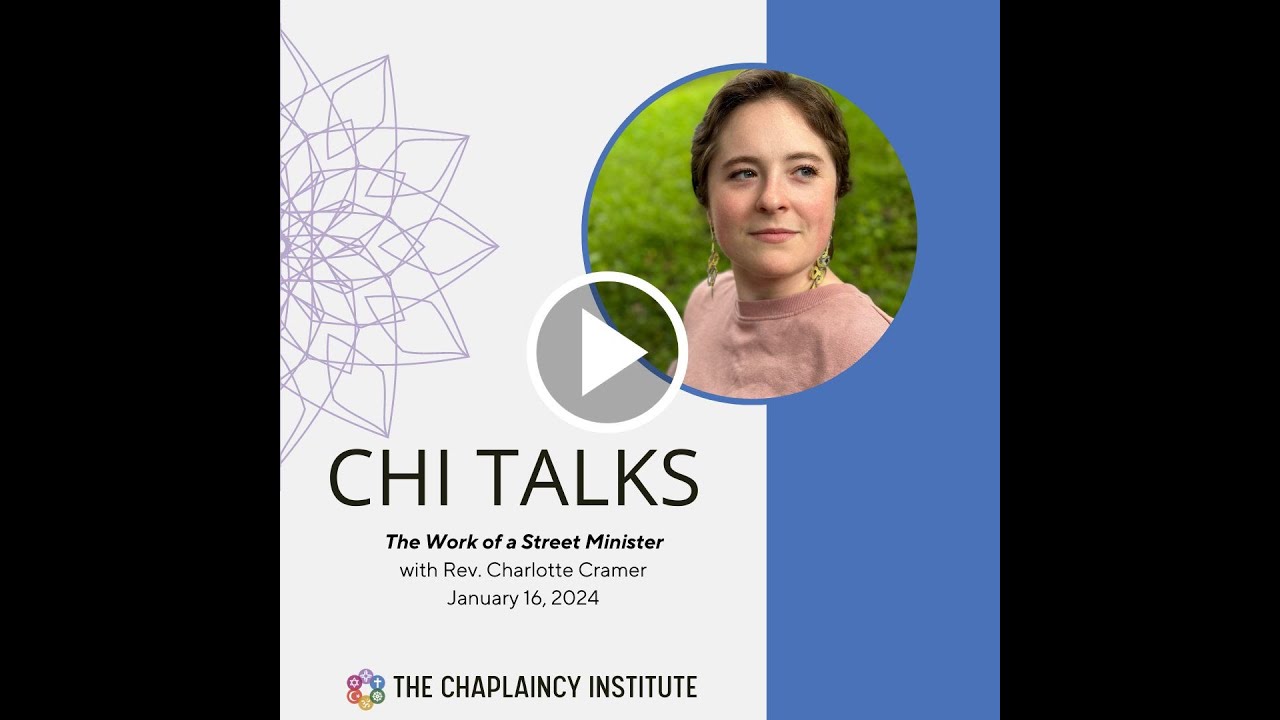
ChI Talks: The Work of a Street Minister with Rev. Charlotte Cramer

Meditations on the Transformative Power of Street Ministry

Meet Our Board

Kelly Ann Nelson
From an early age Kelly Ann (KA) was drawn to creative pursuits. She studied opera for many years and eventually found a home in the Bay Area’s underground music scene. KA discerned her call to ministry in 2016 after tragedy befell this beloved community. Since then, she has traversed her path in earnest, returning to school to obtain her AA in Arts and Humanities, BA in Religious Studies, and received her M.Div. from Starr King School for the Ministry concurrent to her interfaith ordination from the Chaplaincy Institute in June 2024. For three years she served as a director at San Francisco Night Ministry helping to build programming for lay spiritual care providers to serve on a crisis line as well as on the streets. For the last three years she has been a full-time hospital chaplain in Marin County and is called to work with patients in acute psychiatric crises.

Emma Sullivan Uebele
Emma holds an MA in Expressive Arts Therapy for Conflict Transformation and Peacebuilding from the European Graduate School (2020) and a BA in International Communications from American University in Washington, DC (2013). She has a multifaceted practice which includes coaching individual clients through expressive arts, facilitating international projects in conflict zones, and offering trauma competency consulting for organizations and government entities. Emma’s work focuses on the impact of trauma, whether experienced directly or vicariously, utilizing psychoeducation, somatic practices, and the arts as tools for restoration and healing.

Alicia Owens
Alicia Owens is a peer facilitator and survivor of homelessness whose lived experience fuels her deep empathy and leadership. She offers a grounded awareness of how spirituality impacted her survival of homelessness, as well as her ongoing mental and emotional recovery from the trauma. Alicia hopes to share the impact and importance of spiritual care and how it can truly change survivors’ lives for the better.
.jpeg)
Susan Spencer
A strategist, communicator, and writer, Susan Spencer, founder of Susan Spencer Consulting, brings authority, innovation, and expertise to her client portfolio. A longtime publishing executive, she was the editor in chief of Woman’s Day and womansday.com, owned by Hearst. She revitalized the magazine during her almost 10-year tenure by connecting deeply with its audience of 15+ million American women and bringing it back to its roots as an inspirational source of information. Under her leadership, the magazine was the top-selling monthly on U.S. newsstands from 2016-2020.
Susan pivoted into communications in 2020, joining Avoq, a strategic communications and public affairs agency in New York and Washington, DC., as Senior Vice President, Reputation Management. She continues to advise Avoq as a senior consultant.
Deeply committed to service, Susan sits on the boards of Women Heart, a Washington, DC, patient-centered nonprofit that supports women with heart disease, and advises the board marketing and development committee of Safe Horizon, the nation’s largest nonprofit victim services organization. In 2023, she was appointed to the National Heart, Lung and Blood Institute’s Advisory Council at the National Institutes of Health (NIH). Closer to home, she has volunteered for more than a decade at a community food pantry.
Susan lives in New Jersey with her husband and is the proud mother of two amazing young women.